
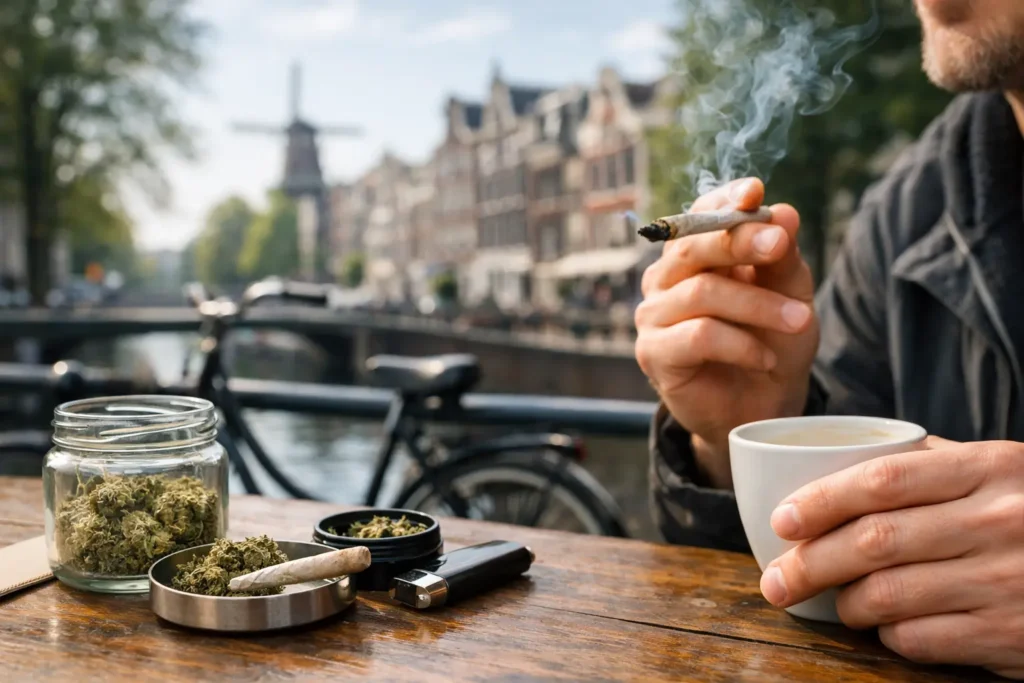
Amsterdam has earned its cannabis reputation for a reason, but weed in Amsterdam is not a law-free tourist attraction. The city offers a well-known, regulated-tolerance system centered on licensed coffeeshops, alongside rules that can surprise visitors who assume they can smoke anywhere or carry cannabis home. A little preparation lets you enjoy the culture without turning a relaxed trip into a legal weed hiccup.
Is weed legal in Amsterdam?
The short answer is: not fully, but personal use and coffeeshop sales are tolerated under strict conditions. Dutch law still prohibits cannabis production, possession, and sale in principle. In practice, authorities generally tolerate the sale of small amounts from licensed coffeeshops that follow national and local rules.
For travelers, the practical distinction matters less than the boundaries. You can buy and consume cannabis at an approved coffeeshop, but that does not mean cannabis is permitted in every public space, hotel room, park, or transit area. Dutch tolerance is a policy choice with limits, not blanket legalization.
Coffeeshops may sell up to five grams of cannabis per person per day. You must be at least 18 and should expect to show a valid physical ID. A passport is the most reliable option for US visitors. Do not rely on a photo of your ID on your phone.
Amsterdam does not generally enforce a residents-only rule at coffeeshops, so adult tourists can visit. That is not true everywhere in the Netherlands, and municipal policies can change. If you travel beyond Amsterdam, check the rules for your next destination rather than assuming the same approach applies.
How Amsterdam coffeeshops work
A coffeeshop is a licensed cannabis venue, not a regular coffeehouse and not necessarily a place where you will find espresso and pastries. Some are compact counter-service shops; others have a lounge-like setting where adults can sit, talk, and consume. The atmosphere varies widely, from quiet and local to crowded and unmistakably tourist-oriented.
Look for an official licensed coffeeshop, not someone offering cannabis in the street. Street sales are illegal and carry the obvious risks of scams, theft, poor-quality products, and contact with unregulated substances. If a deal sounds unusually cheap or urgent, walk away.
Inside, take a moment to read the menu and ask simple questions. Staff are used to visitors, including people with limited experience. Be honest about your tolerance. A product’s name alone does not tell you how it will affect you, and potency can be much higher than what some travelers are used to at home.
Edibles deserve extra patience. Their effects can take an hour or more to arrive, then last far longer than inhaled cannabis. The common travel mistake is taking another portion because the first one seems ineffective. Start with a low amount, wait, and avoid mixing edibles with alcohol or other drugs.
Many coffeeshops restrict or prohibit tobacco smoking indoors. Dutch smoking rules are serious, and venues may provide or allow tobacco-free herbal mixes instead. Follow the house rules, ask before rolling anything, and do not assume every seat is a consumption area.
Weed in Amsterdam: where you can and cannot smoke
The safest place to consume cannabis is inside a coffeeshop that permits on-site use or in a private accommodation where the host explicitly allows it. That second part is essential. Many hotels, hostels, apartment rentals, and houseboats prohibit smoking of any kind, and cannabis odor can lead to cleaning charges or removal from the property.
Public consumption is where visitors most often misread the city. Amsterdam has designated areas where smoking cannabis in public is prohibited, including parts of the central city around the Red Light District. Signs and local enforcement notices matter. Ignoring them can lead to a fine, even if the street nearby is full of tourists.
More broadly, using cannabis in busy public places, around children, near schools, on public transportation, or in areas with clear no-smoking signs is a bad idea. The city wants to reduce nuisance, especially in crowded neighborhoods. Respecting that goal is both courteous and practical.
Do not smoke while driving, cycling, or operating a scooter. Cannabis-impaired driving is illegal, and Dutch roads are not the place to test your balance or reaction time. Amsterdam cycling can be intense even when completely sober: trams, pedestrians, fast local riders, narrow lanes, and unfamiliar traffic patterns all demand attention.
What not to bring across a border
Cannabis purchased in Amsterdam stays in the Netherlands. Do not take it through Schiphol Airport, onto an international train, onto a cruise ship, or across any national border. This includes flower, hash, edibles, vape cartridges, and CBD products that may contain THC.
US travelers sometimes assume that a legal state at home changes the risk. It does not. International travel is governed by border and customs laws, and cannabis remains illegal under US federal law. Packaging something discreetly does not make it lawful, and it can create serious consequences.
The same caution applies when arriving in Amsterdam. Do not bring cannabis from home, even if it was legally purchased where you live. Start your trip with an empty bag and leave with one.
Local etiquette makes the experience better
Amsterdam residents live in a major city, not a permanent bachelor-party set. Keep your volume down outside, do not block bike lanes or doorways, and avoid treating residential streets as a smoking lounge. A relaxed, low-key approach travels much better than loud public consumption.
Be mindful of friends who are not consuming. Cannabis can be a shared part of a trip without becoming the entire itinerary. Plan food, museums, canals, music, and a sober route back to your accommodation. If you are trying a product for the first time, choose a calm setting and leave the bike rental for another day.
It also helps to understand the difference between cannabis culture and tourism theater. The best coffeeshop for you may not be the one with the loudest sign or longest social media line. A smaller, orderly place with clear house rules and staff willing to answer basic questions can make a much more comfortable first visit.
A practical plan for first-time visitors
Bring your passport, carry only what you expect to use, and keep your receipt and purchase discreetly stored. Choose one licensed coffeeshop, take your time, and avoid combining cannabis with a heavy drinking day. If you select an edible, make that your main intoxicant for the evening rather than adding alcohol, mushrooms, or other substances.
If you feel uncomfortably high, move to a quiet, familiar place, drink water, eat something light, and stay with a trusted friend if possible. The sensation is temporary, even when it feels intense. Seek medical help if someone has severe symptoms, loses consciousness, experiences chest pain, or becomes a danger to themselves or others.
Rules, opening practices, and local enforcement priorities can shift, particularly in busy central areas. Check current notices once you arrive, listen to venue staff, and follow posted restrictions. Being cannabis-positive and being responsible are not competing ideas in Amsterdam. The travelers who have the best experience are usually the ones who treat the city’s tolerance with the same respect they expect from it.
